
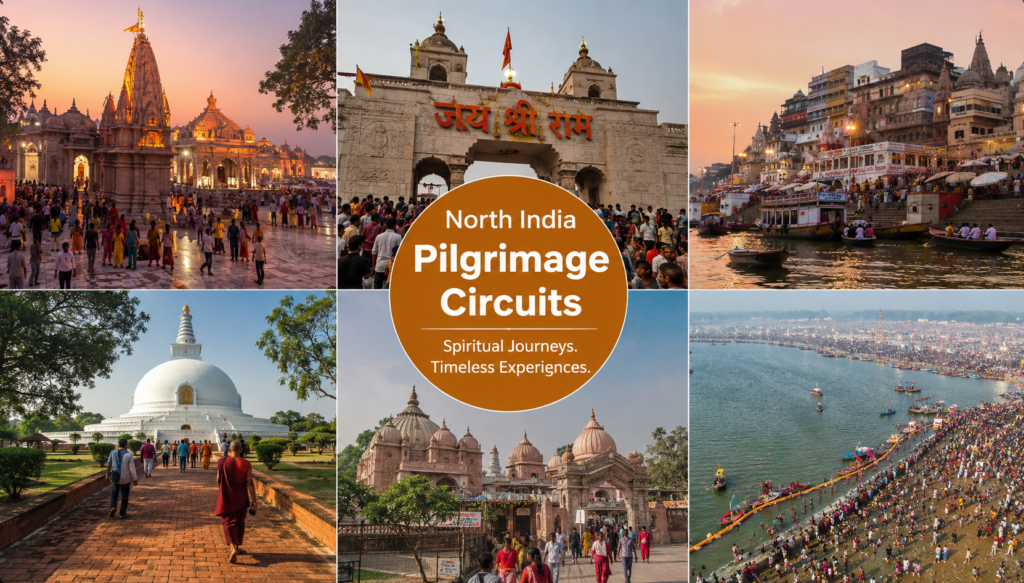
At 4:30 in the morning, the ghats of Varanasi are already awake.
Temple bells from Kashi Vishwanath Temple begin before sunrise. Priests move quietly through narrow गलियाँ near Godowlia. Pilgrims arrive carrying steel thalis, flowers wrapped in newspaper, and expectations built over decades. Some have waited their entire lives for this darshan.
This is where pilgrimage operations stop being “travel planning” and become responsibility.
For B2B pilgrimage operators, international wholesalers, and travel agents, North India spiritual circuits demand more than hotel bookings. They require timing, darshan management, crowd intelligence, local coordination, temple protocol understanding, and ground teams that know what happens when flights delay, VIP movement begins, or festival crowds suddenly triple.
We actively handle B2B ground operations across:
- Ayodhya
- Varanasi
- Prayagraj
- Chitrakoot
- Mathura–Vrindavan
- Buddhist Circuit including Bodh Gaya, Sarnath, Kushinagar, Shravasti, Rajgir, Nalanda, and Lumbini
For serious pilgrimage movement, the right DMC is not optional. It is operational insurance.
Why Travel Agents Choose a Specialist Pilgrimage DMC
A strong pilgrimage DMC protects your reputation, your margins, and your client experience. Generic suppliers often sell transport and hotels. A real pilgrimage ground handler manages timing, ritual expectations, local sensitivities, and problem prevention before they become complaints.
The difference is rarely visible on paper—but it becomes obvious on arrival.
What Actually Matters in Pilgrimage Operations
Most agents focus first on hotel rates.
Experienced operators focus first on:
- temple access timing
- darshan slot strategy
- VIP movement restrictions
- local crowd behavior
- railway station transfers
- airport proximity
- festival congestion planning
- multilingual guide availability
- pure vegetarian meal reliability
- elderly traveler movement support
- wheelchair and assisted darshan planning
In pilgrimage travel, logistics decide satisfaction more than luxury.
Proof-Based Ground Handling Authority
We manage:
- fixed departure pilgrimage groups
- Buddhist inbound series departures
- FIT spiritual travel
- VIP darshan movement support
- MICE-linked spiritual extensions
- festival season operations
- charter and rail-linked pilgrim movements
- multi-city North India sacred circuits
From airport pickup to final temple exit, execution matters more than promises.
Ayodhya Ground Handling for B2B Pilgrimage Operators
Ayodhya is no longer just a devotional destination—it is now one of India’s fastest-growing high-volume pilgrimage sectors. Handling Ayodhya requires crowd strategy, temple access planning, and supplier strength that can survive peak-season pressure.
This is not a city where last-minute improvisation works.
Key Entities That Matter
- Shri Ram Janmabhoomi Mandir
- Hanuman Garhi
- Kanak Bhawan
- Saryu Ghat
- Maharishi Valmiki International Airport
- Ayodhya Dham Junction
Reality vs Expectation
Many assume Ayodhya is a simple one-day darshan city.
In reality, movement planning is highly sensitive to crowd control, security routing, and darshan timing. Peak season delays can turn a three-hour movement into eight.
The wrong hotel location alone can destroy group flow.
Varanasi and Prayagraj Operations
Varanasi and Prayagraj are often sold together, but operationally they behave very differently. One is spiritual intensity through ritual; the other is scale through sacred convergence.
Both require precision.
Varanasi Core Movement Points
- Kashi Vishwanath Temple
- Dashashwamedh Ghat
- Assi Ghat
- Sarnath
- Lal Bahadur Shastri International Airport
- Varanasi Junction
Prayagraj Core Movement Points
- Triveni Sangam
- Hanuman Mandir
- Akshayavat
- Prayagraj Airport
- Prayagraj Junction
What Most Travelers Miss
Ganga Aarti is not “just an evening event.”
Boat access, elderly movement, ghat approach timing, crowd density, and weather conditions completely change the experience.
A good operator plans the emotion, not just the schedule.
Chitrakoot and Mathura–Vrindavan Circuit Handling
Chitrakoot and Mathura–Vrindavan serve very different traveler psychology—one is reflective, one is devotional intensity.
Both require cultural interpretation.
Chitrakoot Key Sites
- Kamadgiri
- Ram Ghat
- Gupt Godavari
- Bharat Milap Temple
Mathura–Vrindavan Key Sites
- Shri Krishna Janmabhoomi
- Banke Bihari Temple
- Prem Mandir
- ISKCON Temple
- Mathura Junction
Cultural Interpretation Matters
In Vrindavan, temple movement is emotional and often spontaneous.
In Chitrakoot, silence matters more than spectacle.
Pilgrimage handling improves when operators understand behavior, not just geography.
Buddhist Circuit Ground Handling for International Wholesalers
The Buddhist Circuit is not a sightseeing route. It is a spiritual map.
International Buddhist groups—from Thailand, Sri Lanka, Vietnam, Japan, Korea, and Myanmar—travel with ritual priorities, monastic protocol expectations, and deep emotional significance.
This requires specialized handling.
Core Buddhist Circuit Destinations
- Bodh Gaya – Mahabodhi Temple
- Sarnath – Dhamek Stupa
- Kushinagar – Mahaparinirvana Temple
- Shravasti
- Rajgir
- Nalanda
- Lumbini
Why Buddhist Groups Need Specialist Handling
They require:
- monastery meal coordination
- meditation timing respect
- multilingual escorts
- temple etiquette understanding
- prayer stop flexibility
- airport + border movement precision
- cross-border Nepal coordination
- VIP monastic delegation handling
A standard leisure operator usually fails here.
Why Choose Us vs Local Suppliers
Local suppliers sell one city.
A serious pilgrimage DMC manages the full sacred journey.
That difference protects your clients and your business.
What Works Better
With fragmented suppliers:
- inconsistent service standards
- poor escalation support
- weak festival readiness
- no cross-city accountability
- darshan failures become your problem
With a specialist DMC:
- single operational control
- uniform service standards
- dedicated escalation handling
- better hotel and transport leverage
- stronger VIP and festival execution
- one accountable ground partner
Pilgrimage is trust-sensitive. Fragmentation is expensive.
Practical Travel Tips for B2B Partners
The best pilgrimage planning happens before quotation stage. Asking the right operational questions early prevents most on-ground failures.
Mistakes to Avoid
- underestimating temple crowd timings
- selling unrealistic darshan windows
- ignoring railway arrival fatigue
- choosing hotels too far from temple zones
- assuming airport proximity means faster access
- missing festival blackout dates
- not planning pure veg meal standards
- treating Buddhist groups like leisure groups
Frequently Asked Questions
How many days are enough for Ayodhya, Varanasi and Prayagraj?
For a meaningful pilgrimage circuit, 5 to 7 days works best. This allows proper darshan, Ganga Aarti, Sangam rituals, transfer buffers, and senior traveler comfort without rushing sacred experiences.
Shorter trips usually create fatigue and missed rituals rather than satisfaction.
Do you handle Buddhist inbound groups?
Yes, Buddhist inbound series departures require dedicated handling, not standard sightseeing operations. Monastery meals, prayer schedules, multilingual guides, and cross-border Nepal coordination must be planned differently.
This is one of the most operationally sensitive pilgrimage segments.
Can VIP darshan arrangements be managed?
Yes, depending on destination protocols, festival conditions, and temple regulations. VIP movement must be planned in advance and aligned with local administrative permissions and temple systems.
Last-minute expectations usually create disappointment.
Which is better for first-time spiritual groups: Ayodhya or Varanasi?
For emotional first-time devotion, Ayodhya feels direct and structured. For deeper spiritual intensity and ritual immersion, Varanasi offers a far stronger experience.
The right choice depends on traveler expectation, not destination popularity.
Is Mathura–Vrindavan suitable for senior citizen groups?
Yes, but only with strong movement planning. Temple crowds, walking intensity, and darshan flow require proper pacing, assisted access, and carefully chosen hotel locations.
Without that, fatigue becomes the main memory.
What is the best season for North India pilgrimage circuits?
October to March is operationally strongest for most circuits due to weather comfort and smoother movement. Festival periods are powerful but require much earlier planning because demand and crowd pressure rise sharply.
Peak devotion season also means peak operational risk.
Some journeys stay in memory.
The right pilgrimage journeys stay in the senses—the sound of morning bells in Kashi, the stillness of Bodh Gaya before sunrise, the dust of parikrama paths in Chitrakoot, the first glimpse of Ram Janmabhoomi in Ayodhya.
For B2B partners, that memory becomes your reputation.
And reputation is built on ground handling.
Not promises.
Ready to Grow Your B2B Travel Business?
Connect with our team instantly on WhatsApp and unlock exclusive DMC deals.
Chat on WhatsApp